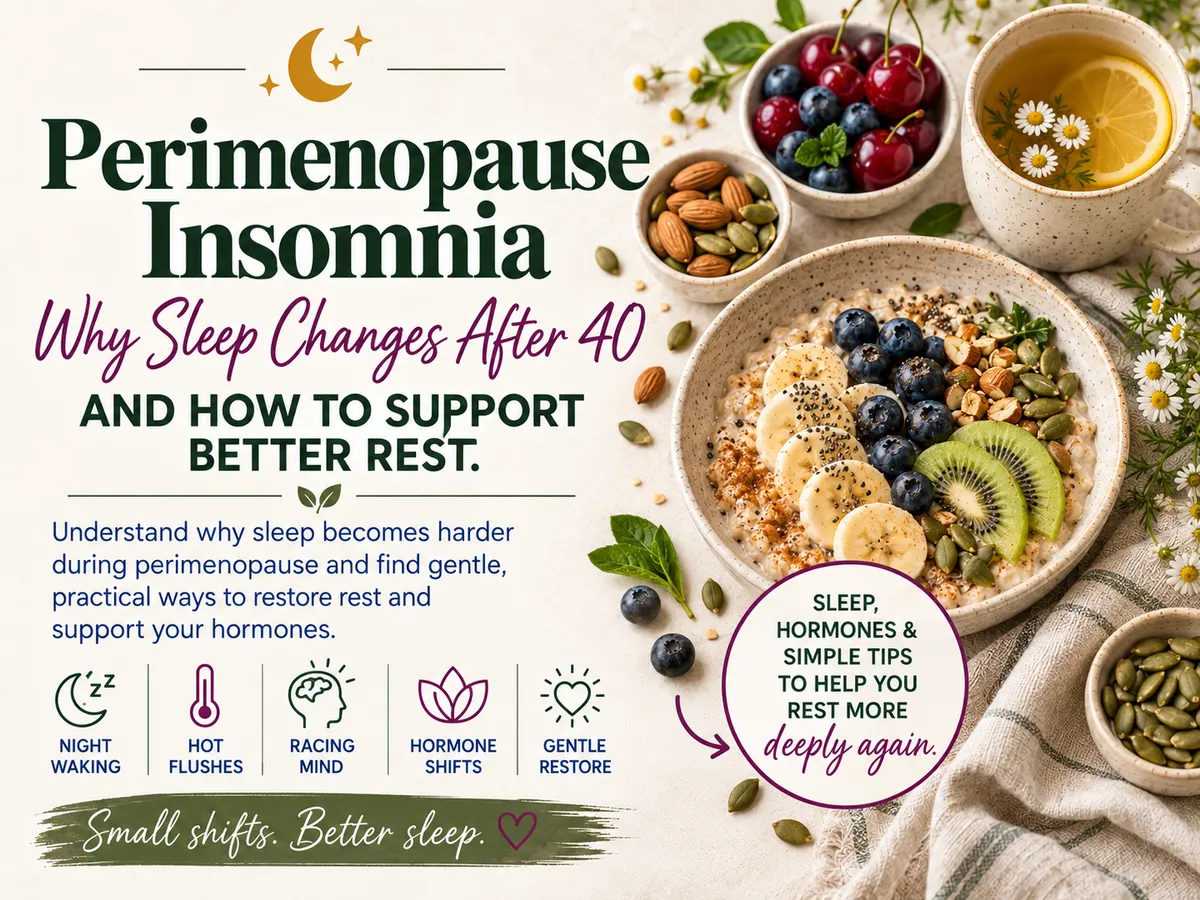
Perimenopause Insomnia: Why Sleep Changes After 40 and How to Support It Naturally
Perimenopause Insomnia: Why Sleep Changes After 40 and How to Support It Naturally
If you fall asleep easily and then find yourself wide awake at three in the morning, or you have started waking several times a night for no clear reason, perimenopause is very likely involved. This guide explains what changes in the body during the menopausal transition, why night waking becomes so common, and what genuinely helps restore a natural rhythm.
Category: Sleep and Recovery | Read time: 9 minutes
Key Takeaways
Sleep disturbance is one of the most common experiences of the menopausal transition, reported by a large proportion of women.
Staying asleep tends to become harder than falling asleep, which is the opposite of what most sleep advice addresses.
Night sweats and hot flashes are a major driver of night waking, but they are not the whole story.
Falling progesterone removes some of the body's natural calming support, which is why the same day's stress lands differently at night.
For persistent insomnia, cognitive behavioral therapy is the treatment with the strongest evidence behind it, ahead of supplements or sleeping tablets.
Why Sleep Changes During Perimenopause
Perimenopause is the time leading up to your final period, and the Office on Women's Health notes it usually begins in a woman's mid to late forties. It commonly lasts between two and eight years.
Across those years, estrogen and progesterone fluctuate rather than declining smoothly. Both hormones are involved in sleep, which is why sleep is so often one of the first things to shift.
Estrogen helps regulate body temperature. As it becomes less stable, the body's ability to hold a steady overnight temperature is affected, which is closely tied to the night sweats many women experience.
Progesterone has a calming, sleep-supporting effect on the nervous system. As it becomes less consistent, that natural buffer thins. The day's stress that you managed perfectly well at four in the afternoon can arrive uninvited at three in the morning.
This is the important point. Your sleep is not worse because you have become worse at sleeping. The conditions have changed.
Sleep is often one of several changes arriving together at this stage. There is a fuller overview in perimenopause symptoms in women over 40.
How Common Is This?
Reviews of sleep across the menopausal transition report that 40 to 60 percent of women experience sleep disturbance during these years. Around 26 percent of perimenopausal women meet the diagnostic criteria for insomnia disorder.
Research also shows that perimenopausal women have roughly 1.6 times the odds of sleep disruption compared with women who have not yet entered the transition.
The Study of Women's Health Across the Nation found that among midlife adults aged 45 to 64, around 31 percent of women were sleeping less than seven hours on average.
There is an encouraging finding in that same long-term research. Sleep problems do not worsen indefinitely for most women. When researchers followed women for around 15 years, the group whose sleep problems kept increasing was the smallest, at about 15 percent. For most, this is a difficult phase rather than a permanent new state.
The 3am Waking Pattern
This is the complaint I hear most often, and it has a particular shape. You fall asleep without difficulty. You sleep soundly for a few hours. Then you are suddenly and completely awake, often between two and four, with a mind that has decided this is a sensible time to review everything.
Several things are happening at once.
Your Deepest Sleep Is Behind You
The first half of the night holds most of your deep sleep. By the early hours you are moving through lighter stages, which means it takes much less to wake you than it would have done three hours earlier.
Cortisol Begins Its Morning Rise
Cortisol naturally starts climbing in the early hours to prepare you to wake. If your stress response has been running high, that rise can begin too early or too steeply, and it wakes you before you are ready.
This is why night waking and daytime stress are so closely connected. There is more on that pattern in the signs of high cortisol in women over 40.
Blood Sugar Can Dip Overnight
If dinner was early, light, or low in protein, blood sugar can fall during the night. The body responds by releasing stress hormones to correct it, and that response is perfectly capable of waking you.
Women who notice they wake feeling slightly shaky, unusually warm, or with a racing heart often find this is the piece worth addressing. The guide to balancing blood sugar naturally after 40 covers the daytime side of this.
A Night Sweat You Did Not Fully Register
Not every hot flash wakes you enough to remember it. Some simply lift you into a lighter stage of sleep, and you surface a few minutes later without connecting the two.
Night Sweats and Why They Matter So Much
The link between hot flashes and broken sleep is stronger than most women realize.
Research following 3,045 women through the Study of Women's Health Across the Nation found that those with moderate to severe hot flashes were almost three times more likely to report frequent night waking than women without them.
When hot flashes have been measured objectively in sleep laboratories, they accounted for around 27 percent of the time spent awake after falling asleep. Roughly 69 percent of hot flash events coincided with a recorded awakening.
That is a substantial share of lost sleep coming from a single cause. It also means that anything which reduces the intensity of night sweats tends to improve sleep as a side effect, which is worth knowing when you are deciding where to put your effort.
Practical things that help:
Keep the bedroom genuinely cool, cooler than feels necessary at bedtime
Layer bedding so you can adjust without fully waking
Choose natural fibers for nightwear and sheets
Keep water within reach so you do not have to get up
Notice whether alcohol, spicy food, or a warm room in the evening makes yours worse
Falling Asleep or Staying Asleep?
This distinction matters, because most sleep advice is written for the first problem while perimenopause usually produces the second.
Trouble falling asleep: Responds well to wind-down routines, light management, and evening habits → Trouble staying asleep: Responds better to temperature, evening nutrition, and daytime stress regulation
Night waking is the most commonly reported sleep complaint during the menopausal transition. If you have been diligently following advice about screens and bedtime routines without much improvement, this may be why. You have been solving a different problem.
For general sleep foundations, which still matter and still apply, how to improve sleep naturally after 40 covers that ground properly. This article stays with the perimenopause-specific piece.
What Helps With Perimenopause Night Waking
The habits below are chosen specifically for staying asleep rather than falling asleep.
Eat enough at dinner, with protein.
An early or very light dinner is one of the more common causes of a 3am waking. Including protein helps hold blood sugar steadier through the night.
Keep the room cooler than feels comfortable at first.
Your body temperature needs to fall for sleep to deepen, and perimenopause makes that harder. A cool room does some of that work for you.
Get daylight into your eyes in the morning.
This anchors your body clock and supports melatonin at the right end of the day. It is one of the few sleep habits that works on the following night rather than the current one.
Move your caffeine earlier.
Caffeine has a long tail. Something you drink at two in the afternoon can still be affecting how deeply you sleep at midnight.
Be honest about alcohol.
A glass of wine helps most people fall asleep and reliably fragments the second half of the night. During perimenopause that effect tends to be more pronounced.
Do the stress work in the daytime.
Night waking is very often a daytime nervous system pattern showing up after dark. Slow breathing, time outdoors, and genuine pauses in the day do more for 3am than anything you can do at 3am. There is more in calming the nervous system after 40.
If you wake, do not fight it.
Lying there willing yourself back to sleep raises alertness. If you are awake beyond around twenty minutes, get up, keep the light low, do something undemanding, and return when you feel sleepy.
Support magnesium intake through food.
Magnesium is involved in both nervous system regulation and sleep. Leafy greens, pumpkin seeds, almonds, and black beans are good sources, and there is more detail in magnesium for women over 40.
When It Is More Than Perimenopause
Not all midlife sleep disruption is hormonal, and a few causes need proper assessment rather than gentle habits.
Please speak to your doctor if you notice:
Snoring, gasping, or pauses in breathing that a partner has mentioned
Waking with headaches, or severe daytime sleepiness despite time in bed
Restless, crawling sensations in the legs at night
Low mood, persistent anxiety, or early morning waking alongside the sleep problem
Insomnia that has continued most nights for three months or more
Sleep apnea becomes more common in women after menopause, partly because the protective effect of reproductive hormones is lost. It is frequently missed in women, and it is very treatable once identified.
The Treatment With the Strongest Evidence
If your insomnia has become persistent, it is worth knowing what the research actually supports.
The American College of Physicians recommends cognitive behavioral therapy for insomnia, known as CBT-I, as the first-line treatment for adults with chronic insomnia. Their guidance notes that "CBT-I is an effective treatment and can be initiated in a primary care setting."
It is a structured, practical approach rather than open-ended talking, and it is available through apps, online programs, and self-help materials as well as in person. It sits ahead of both supplements and sleeping tablets in the evidence, which surprises most people.
It is also reasonable to ask your doctor about hormone therapy if night sweats are the main driver of your waking. That is an individual conversation and depends on your own health history, but it belongs on the list of options rather than off it.
What Progress Usually Looks Like
Sleep rarely improves in a straight line, and expecting it to is a reliable route to discouragement.
Weeks one to two: Falling asleep gets easier, night waking continues → Weeks three to six: You wake less often, or settle again more quickly → Months two to three: Mornings feel more restored, even on imperfect nights
Progress often shows up first as returning to sleep faster, rather than as not waking at all. That is a real improvement and worth noticing.
A Gentle Place to Start
Broken sleep is genuinely hard, and it makes everything else in this stage of life harder to manage. It is also one of the areas where small changes reliably help.
If you only change one thing, make it dinner. Eating enough, with protein, and not too early, resolves more 3am waking than any supplement on the shelf. Give it two weeks before you judge it.
And if the tiredness has become the bigger problem, perimenopause fatigue and how to restore your energy looks at the daytime side of this same picture.
This phase does not last forever, and your sleep is not broken. It is asking for different support than it used to need.
If you would like more structured support with sleep, hormones, stress, and sustainable wellness after 40, the membership brings these pieces together into an approach you can actually follow.