Strength Training for Women Over 40: Why Muscle Matters and How to Start
Strength Training for Women Over 40: Why Muscle Matters and How to Start
If you have noticed your body responding differently to exercise than it used to, or you have wondered whether weights are really necessary at this stage of life, you are not alone. Strength training is one of the most supportive things you can do for your body after 40, and it does not need to be complicated or intense to make a real difference. This guide covers why muscle matters more now, what the research shows, and how to begin gently.
Category:Movement and Metabolism | Read time:7 minutes
Key Takeaways
Muscle loss can begin as early as your 30s and tends to speed up during the menopausal transition.
Strength training supports metabolism, blood sugar, bone density, and balance, not just muscle tone.
Only around a quarter of women over 40 currently meet basic strength training guidelines, so starting now puts you ahead.
You do not need a gym or heavy weights to begin. Two sessions a week working the major muscle groups is enough to see benefits.
Why Muscle Matters More After 40
Muscle is not just about how your body looks. It plays a direct role in metabolism, blood sugar regulation, bone strength, balance, and everyday function, things like carrying groceries, climbing stairs, and getting up off the floor with ease.
Research shows that women can lose approximately 0.6 percent of muscle mass per year during their 30s, with the rate of decline increasing further after age 50 (systematic review, National Institutes of Health). This gradual process, known as sarcopenia, does not happen overnight, but it is easier to slow down than it is to reverse.
The encouraging part is that muscle responds well to the right kind of movement at any age. Strength training is one of the few tools that can meaningfully slow this decline, and in many cases, help rebuild what has already been lost.
What Happens to Muscle and Strength During Perimenopause
Hormonal changes during perimenopause play a real role in muscle loss, separate from aging alone. Research shows lean body mass can decrease by around 2.5 percent during perimenopause and by close to 6 percent after menopause, compared with premenopausal levels (narrative review, PMC).
Declining estrogen, progesterone, and testosterone are all associated with reduced muscle strength and power. The quadriceps, the muscles at the front of the thighs, are often among the first to weaken, sometimes as early as the mid-40s. These muscles matter for far more than exercise performance. They support balance, stair climbing, and long-term mobility.
This is not something to feel discouraged by. It is simply useful information, because it explains why workouts that once felt easy may now feel different, and why strength work becomes more valuable, not less, during this stage of life.
How Strength Training Supports Metabolism, Blood Sugar, and Bones
Strength training offers benefits that reach well beyond muscle tone.
Metabolism:muscle tissue is metabolically active, meaning it uses more energy at rest than fat tissue. Maintaining muscle mass helps support a steadier metabolic rate as you age.
Blood sugar:resistance exercise improves how effectively your muscles use glucose, which supports more stable blood sugar balance after 40. This is one of the more overlooked benefits of strength work for women in midlife.
Bone health:a large meta-analysis of randomized controlled trials found that exercise, particularly resistance training performed three times a week for at least six weeks, meaningfully improved lean body mass and strength in menopausal women (systematic review and meta-analysis, National Institutes of Health). Since bone density often declines alongside muscle during this transition, strength training supports both at once.
Reactive: Energy spikes and crashes after meals →Regulated:Steadier energy when muscle is actively used and maintained
How Often Should Women Over 40 Strength Train
The Centers for Disease Control and Prevention recommends muscle-strengthening activity at least two days a week, covering all the major muscle groups: legs, hips, back, chest, shoulders, and arms (CDC Physical Activity Guidelines).
Despite this guidance, only around 24 percent of women aged 45 to 64 currently meet the muscle-strengthening guideline, compared with around 30 percent of men in the same age group (National Health Interview Survey, CDC). This is not a criticism. It simply reflects how little consistent guidance and encouragement women in this age group tend to receive around strength work specifically.
Two sessions a week is a realistic, achievable starting point. You do not need daily workouts to see meaningful change.
How to Start If You Have Never Lifted Weights
Starting strength training for the first time, or returning to it after years away, can feel intimidating. A few gentle principles make it easier:
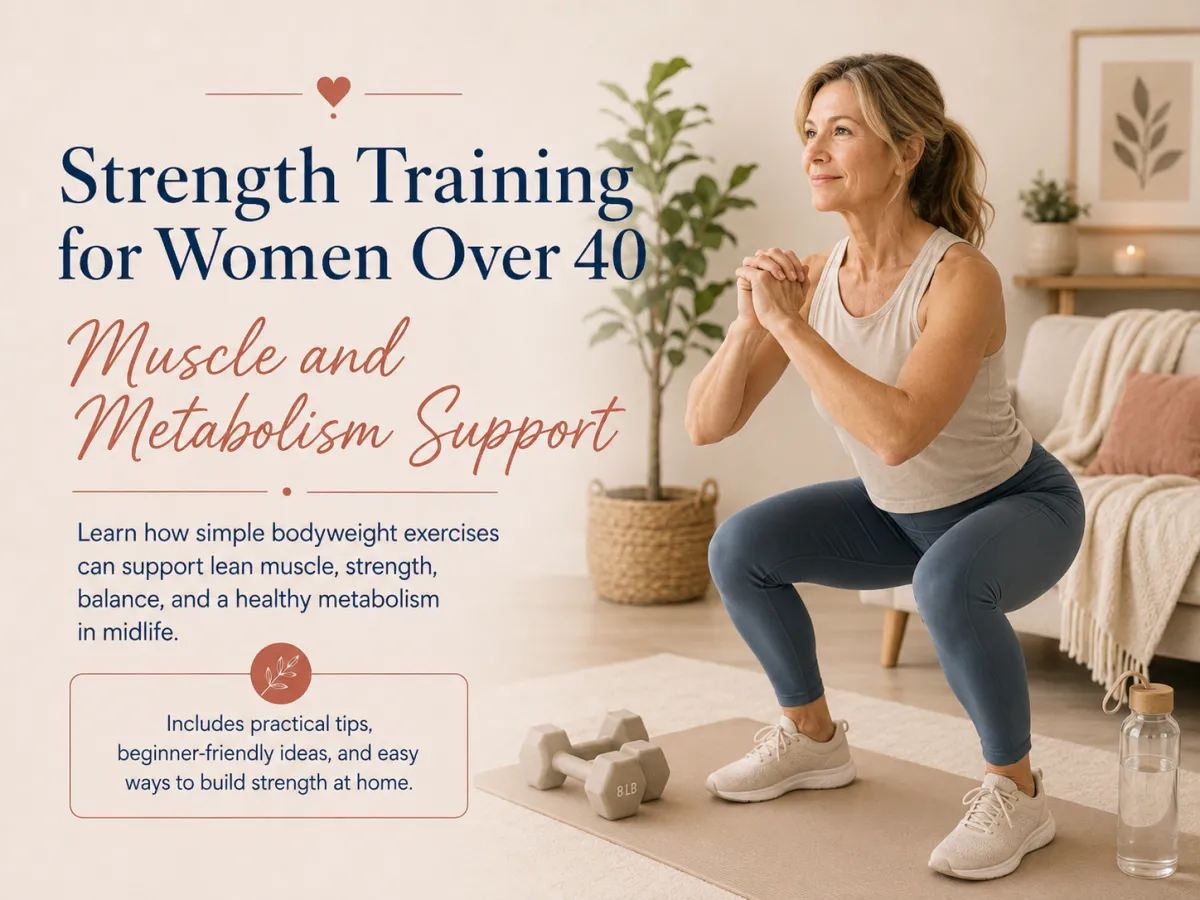
Start with bodyweight movements.Squats, wall push-ups, and step-ups build a foundation without any equipment.
Focus on form before load.Learning to move well matters more early on than how much weight you lift.
Rest between sessions.Muscles rebuild during recovery, not during the workout itself, so avoid training the same muscle group on consecutive days.
Choose a weight that challenges you by the last few repetitions.Aim for 8 to 12 repetitions per exercise, working to the point where the last couple feel difficult but manageable (CDC Physical Activity Guidelines).
Progress slowly.Small, gradual increases in resistance are more sustainable than jumping in too fast.
Simple At-Home Strength Movements to Begin With
These movements cover the major muscle groups and require little to no equipment:
Bodyweight squats or chair squats
Wall push-ups or knee push-ups
Standing rows using a resistance band
Glute bridges
Step-ups using a low step or stair
Standing calf raises
Two rounds of 8 to 12 repetitions per movement, twice a week, is a reasonable starting structure. As these begin to feel manageable, resistance bands or light dumbbells are a natural next step.
How Much Protein You Need to Support Muscle After 40
Strength training and nutrition work together. Without enough protein, the body has less raw material to repair and build the muscle tissue that training breaks down.
Mayo Clinic Health System suggests that women in their 40s and 50s benefit from around 1 to 1.2 grams of protein per kilogram of body weight per day to help offset age-related muscle loss, higher than the standard recommended daily allowance. For a full breakdown of what this looks like in practice, this guide to daily protein intake for women over 40 covers exact amounts and easy ways to add more protein without overhauling your diet.
Common Mistakes to Avoid
Only doing cardio.Walking and cardiovascular exercise are valuable, but they do not provide the same muscle-preserving stimulus as resistance training. Both matter, but they serve different purposes.
Avoiding weights out of fear of bulking up.Building visibly large muscle requires a specific, intensive training and eating approach. For most women, strength training simply builds functional strength and definition.
Doing too much too soon.Overtraining without adequate rest can lead to fatigue or injury, particularly when starting out. Two well-structured sessions a week outperform five inconsistent ones.
Skipping the lower body.The quadriceps and glutes are some of the first muscles affected by hormonal changes in midlife, so leg-focused movements deserve consistent attention, not an afterthought.
How Strength Training Fits Alongside Walking, Pilates, and Rest
Strength training does not need to replace the movement you already enjoy. It works well alongside Pilates, walking, and rest days as part of a fuller picture of movement after 40.
A simple weekly rhythm might include two strength sessions, a Pilates or mobility session, some walking, and at least one full rest day. This kind of balance supports recovery and energy through proper rest and mineral support, without the body feeling constantly pushed or depleted.
A Gentle Place to Start
You do not need a gym membership, special equipment, or a complicated plan to begin. Start with two short sessions this week, focused on the simple movements above. Notice how your body feels, and build from there at a pace that suits you.
If you would like more structured support with movement, nutrition, and sustainable wellness after 40, the membership is designed to help you build a foundation that works for your body and your life.