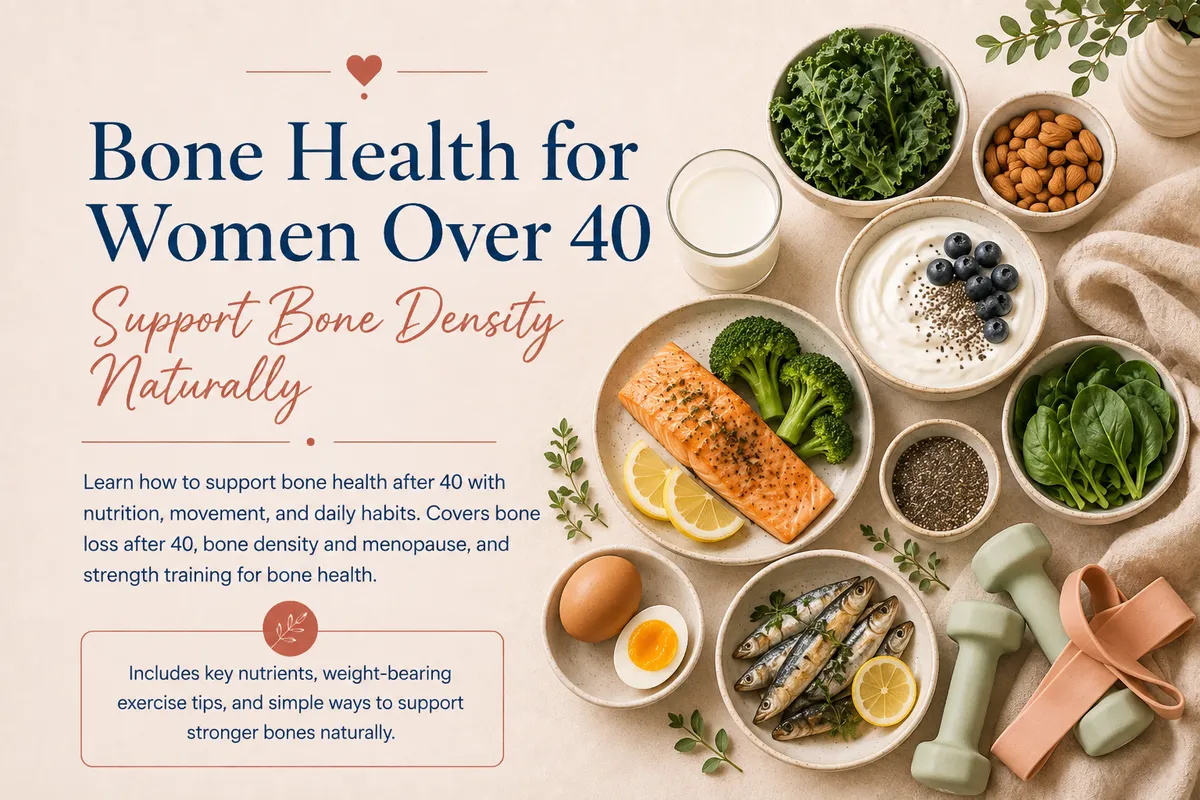
Bone Health for Women Over 40: How to Protect Bone Density Naturally
Bone Health for Women Over 40: How to Protect Bone Density Naturally
Bone loss is one of the quietest changes that happens after 40. There are no symptoms, nothing to feel, and most women only find out when something breaks. The encouraging part is that bone responds to what you do, at any age. This guide explains why bone density changes in perimenopause and the practical steps that genuinely protect it.
Category:Nutrition and Metabolism |Read time:9 minutes
Key Takeaways
A woman can lose up to 20 percent of her bone density in the five to seven years following menopause (Bone Health and Osteoporosis Foundation).
Approximately one in two women over 50 will break a bone because of osteoporosis, yet bone loss itself causes no symptoms.
Strength training does more for bone density than any supplement, because bone responds to load.
Calcium and vitamin D matter, but they work as raw materials. Without the signal from movement, the materials are not put to use.
Protein makes up roughly half of bone by volume, which is why eating too little quietly undermines the rest.
Why Bone Density Changes After 40
Bone is living tissue. It is broken down and rebuilt continuously throughout your life, in a process called remodeling. Cells called osteoclasts remove old bone, and osteoblasts lay down new bone in its place.
For most of adult life these two processes stay roughly in balance. Peak bone mass is typically reached in the late twenties, and then a slow, gradual decline begins. That decline is normal and manageable.
What happens around menopause is different in scale. Estrogen plays a direct role in restraining the cells that break bone down. As estrogen falls, that brake is released, and bone is removed faster than it can be replaced.
The Bone Health and Osteoporosis Foundation reports that a woman can lose up to 20 percent of her bone density during the five to seven years following menopause. That is a meaningful proportion of a lifetime's bone in a relatively short window, and it happens without any sensation at all.
Why This Is Worth Your Attention Now
Bone health tends to be filed away as something to think about later. The difficulty is that the years when the most bone is lost are the years when most women are not thinking about it.
Some figures worth knowing:
Approximately one in two women over 50 will break a bone because of osteoporosis (Bone Health and Osteoporosis Foundation).
Of the estimated 10 million Americans with osteoporosis, about 8 million, or 80 percent, are women.
The Endocrine Society reports that approximately 1 in 10 women over 60 are affected by osteoporosis worldwide.
Bone loss has no symptoms. There is no ache, no stiffness, no early warning. The first sign is often a fracture from something minor, a stumble or a low fall that would not have caused a problem twenty years earlier.
This is not meant to alarm you. It is meant to explain why the work is worth doing during perimenopause rather than after, when the steepest part of the decline has already happened. Bone responds to what you do at any age, but the window during and just after the menopausal transition is the one where effort goes furthest.
Risk Factors Worth Knowing About
Some of these are outside your control, and some are very much within it. Knowing which apply to you helps you judge how much attention this deserves.
Factors You Cannot Change
Being female, and going through menopause
A family history of osteoporosis or hip fracture
Early menopause, before the age of 45
A smaller, slighter frame
Certain medical conditions, including thyroid disorders and celiac disease
Long term use of some medications, particularly corticosteroids
Factors You Can Influence
How much and what kind of movement you do
Protein intake, which is more often too low than too high
Calcium and vitamin D status
Smoking, which reduces bone density directly
Regular high alcohol intake
Long periods of under-eating or restrictive dieting
That last point deserves emphasis. Years of low calorie dieting, common among women who have spent decades trying to manage their weight, is a genuine risk factor for bone loss. If dieting has stopped working the way it used to, that is worth knowing for more reasons than the scale.
Why Strength Training Matters More Than Any Supplement
If you take one thing from this article, make it this one. Bone is built in response to load. When a muscle pulls hard against a bone, the bone receives a signal to become denser at that point. No nutrient can send that signal. Nutrition supplies the materials, but movement is the instruction.
This is why walking, while excellent for many things, has a limited effect on bone density. Your skeleton is already comfortable with the load of carrying you. Meaningful adaptation requires more than it is used to.
The LIFTMOR randomized controlled trial studied 101 postmenopausal women with low bone mass, using supervised high-intensity resistance and impact training twice a week for 30 minutes over eight months. The training group finished with approximately 4 percent better bone mineral density at the lumbar spine and 2 percent better at the femoral neck than the control group.
Those numbers are worth sitting with. Bone density in postmenopausal women is generally expected to decline. Improving it with two half-hour sessions a week is a substantial result.
An important caveat. That trial was supervised, and participants were taught proper technique before loading heavily. This is not a recommendation to lift as heavily as you can without guidance. If you are new to strength training, or you already have low bone density, working with a qualified trainer or physiotherapist for the first few months is genuinely worth the investment.
What Actually Builds Bone
Progressive resistance training.Weights that become gradually heavier over time. The progression is the point.
Compound movements.Squats, deadlifts, presses, and rows load the hip and spine, which are the sites that matter most.
Impact, where appropriate.Skipping, hopping, or step-downs. Only suitable for some women, so check with a professional if you have existing bone loss.
Balance work.This does not build bone, but it prevents the falls that turn low bone density into a fracture.
If you are starting from the beginning, this guide to strength training after 40 covers how to build up sensibly.
Protein and Bone Health
Bone is often pictured as a purely mineral structure, but around 40 percent of bone by dry weight is organic material, and roughly 90 percent of that organic portion is type I collagen. That protein framework is what gives bone its flexibility and resistance to fracture. Minerals provide the hardness, the collagen provides the give, and a bone needs both.
For years, higher protein intake was thought to harm bone. That understanding has since been revised, and current evidence indicates that adequate protein supports bone density, particularly when calcium intake is sufficient.
The practical concern for women over 40 is not eating too much protein. It is eating too little, which is common and works against bone in two ways at once: less collagen framework, and less muscle to pull on the bone in the first place.
There is a full breakdown of how much to aim for in this guide to daily protein intake for women over 40.
Calcium, Vitamin D, Vitamin K2, and Magnesium
These four are frequently discussed together, and it helps to understand what each actually does.
Calcium
The primary mineral in bone. The National Institutes of Health sets the recommended dietary allowance at 1,000 mg per day for women aged 19 to 50, rising to 1,200 mg per day for women aged 51 to 70.
Food sources include dairy, sardines and canned salmon with the bones, tofu set with calcium, leafy greens such as kale and bok choy, almonds, and fortified plant milks. Food sources are generally preferable to supplements where possible.
Vitamin D
Without adequate vitamin D, calcium is poorly absorbed regardless of how much you eat. The National Institutes of Health sets the recommended dietary allowance at 600 IU (15 mcg) per day for adults aged 19 to 70, rising to 800 IU (20 mcg) after 70.
Vitamin D is difficult to obtain from food alone, and levels fall through the darker months for anyone living at higher latitudes. It is one of the few supplements genuinely worth testing for rather than guessing at, so it is worth asking your doctor to check your level.
Vitamin K2
Involved in directing calcium into bone rather than leaving it in soft tissue. Found in fermented foods such as natto, some hard cheeses, and egg yolks. The evidence base is smaller than for calcium and vitamin D, but it is a reasonable part of a varied diet.
Magnesium
The National Institutes of Health reports that 50 to 60 percent of the body's magnesium is present in the bones, and magnesium is involved in converting vitamin D into its active form. Leafy greens, pumpkin seeds, almonds, black beans, and dark chocolate are good sources. There is more detail in this guide to magnesium and mineral support, and on the wider picture in key minerals for women over 40.
How Creatine Fits In
Creatine is usually discussed in the context of muscle, but its relevance to bone is worth understanding, and it comes down to the connection between the two.
Creatine supports the ability to train with more load and recover better between sessions. More load, applied consistently, is the signal bone responds to. Its bone benefit is therefore mostly indirect, working through what it allows you to do in training rather than acting on bone itself.
Research on creatine and bone density directly is still developing, and the strongest evidence remains for muscle strength and function. It is best understood as something that supports the training, rather than a replacement for it. This guide covers creatine for muscle and bone supportin more detail, including dosing and safety.
Foods That Support Bone Health Naturally
No single food protects your bones. A pattern of eating across the week does.
Sardines and canned salmon with bones.Calcium, vitamin D, protein, and omega-3 fats together.
Dairy or fortified alternatives.Yogurt, kefir, and cheese supply calcium alongside protein.
Leafy greens.Kale, bok choy, collard greens, and broccoli. Spinach contains calcium but also oxalates, which reduce absorption, so it should not be your only source.
Nuts and seeds.Almonds, sesame seeds, tahini, and pumpkin seeds.
Tofu set with calcium.Check the label, as not all tofu is prepared this way.
Eggs.Protein, vitamin D, and vitamin K2 in the yolk.
Prunes.A small but consistent body of research links regular prune intake with preserved bone density in postmenopausal women.
Enough food overall.Bone cannot be built during a persistent energy deficit.
Habits That Quietly Work Against Bone Density
Some of these are widely known. Others surprise people.
Long term calorie restriction.
Repeated dieting reduces bone density along with muscle. This is one of the more overlooked costs of decades of weight cycling.
Cardio-only exercise routines.
Excellent for the heart, limited for bone. If your movement is entirely walking, running, cycling, or swimming, your skeleton is receiving very little in the way of a signal to adapt.
Smoking.
Directly reduces bone density and interferes with calcium absorption.
Regular high alcohol intake.
Interferes with the cells that build bone and raises fall risk.
Very low body weight.
Less mechanical loading on the skeleton, and often lower nutrient intake alongside it.
Untreated low estrogen.
Whether from early menopause or another cause, this is worth discussing with your doctor rather than managing alone. There is more context in this guide to estrogen changes in perimenopause.
When to Ask About a Bone Density Scan
A DEXA scan is quick, painless, and involves very little radiation. It gives you an actual number rather than a guess.
It is reasonable to ask your doctor about a scan if you:
Went through menopause before 45
Have a parent who fractured a hip
Have broken a bone from a minor fall after 50
Have taken corticosteroids for an extended period
Have a condition affecting nutrient absorption
Have noticeably lost height
Have a history of long term restrictive eating
Knowing your baseline is useful even if the result is reassuring, because it gives you something to compare against later.
Putting It Together
If this feels like a long list, here is the order of priority. The first item matters considerably more than the last.
First:Strength training twice a week, progressing over time → Second: Enough protein, spread across the day →Third: Calcium from food, and vitamin D checked and corrected →Fourth: Everything else
Most bone health advice reverses this order, leading with supplements because they are easier to sell and easier to start. But the supplements are the raw materials, and without the signal from loading, the materials have nothing to respond to.
A Gentle Place to Start
You do not need a gym membership or a barbell this week. Start where you are.
If you do no strength training at all, begin with two short sessions a week using your own body weight. Squats to a chair, wall push-ups, step-ups, and a carry of something heavy from one room to another. Build from there, adding a little more over time. The progression matters more than the starting point.
At your next appointment, ask about your vitamin D level and whether a bone density scan is appropriate for you. Both are simple requests, and both give you information you can act on.
Bone is not fixed. It is living tissue that responds to how you use it, and the effort you put in during your forties and fifties is what your seventies and eighties will rest on.
If you would like structured support with strength, nutrition, and hormone health after 40, the membership brings these together into an approach designed for this stage of life.