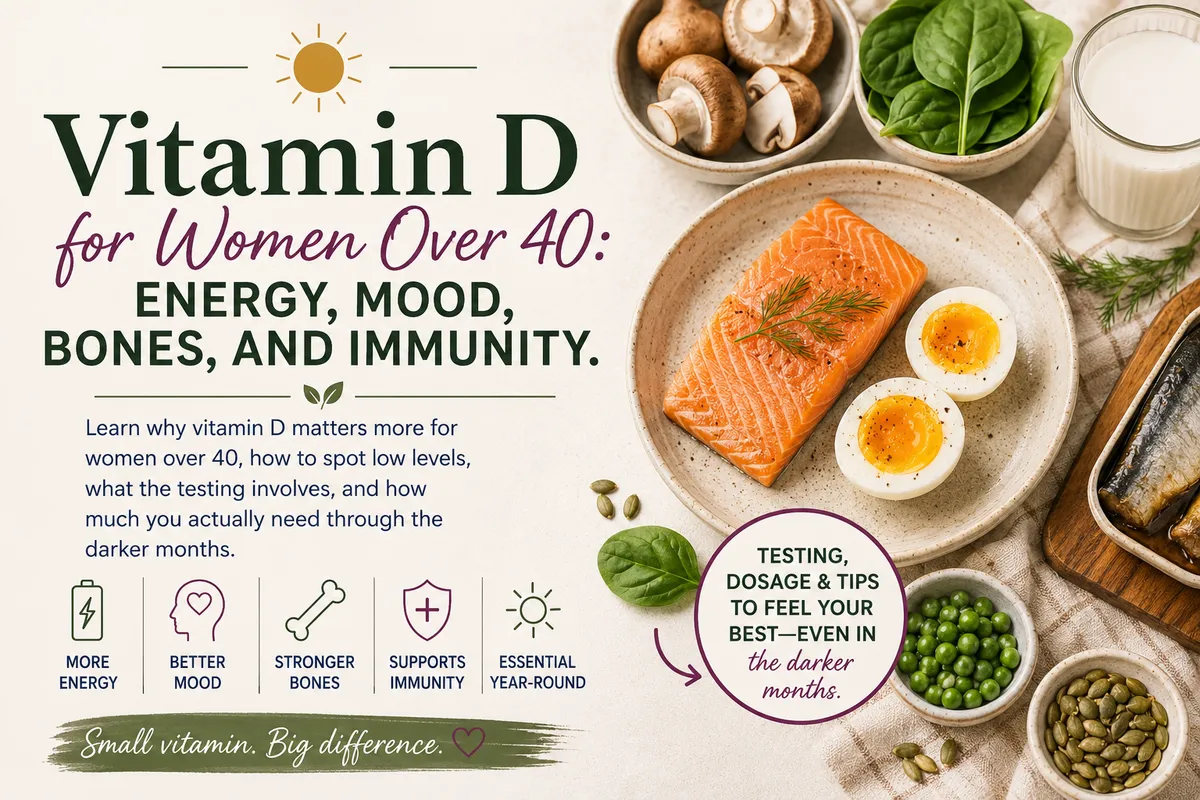
Vitamin D for Women Over 40: Energy, Mood, Bones, and Immunity
Vitamin D for Women Over 40: Energy, Mood, Bones, and Immunity
Vitamin D is one of the few nutrients where guessing rarely works. Levels fall quietly as daylight decreases, the signs of being low are easy to mistake for something else, and the right dose depends on where you are starting from. This guide covers how to recognize low levels, what testing actually tells you, and how much you are likely to need through the darker months.
Category: Nutrition and Metabolism | Read time:9 minutes
Key Takeaways
Vitamin D behaves more like a hormone than a vitamin, which is why it affects so many different systems.
Analysis of NHANES data from 2001 to 2018, covering 71,685 people, found 24.6 percent of the US population deficient and a further 40.9 percent insufficient.
Levels fall predictably as daylight decreases, so late autumn and winter are when most people drop lowest.
This is one of the few nutrients genuinely worth testing rather than guessing, because both too little and too much carry consequences.
Vitamin D3 raises and maintains blood levels more effectively than D2 (National Institutes of Health).
What Vitamin D Actually Does
Vitamin D is usually filed alongside vitamin C and the B vitamins, which undersells it. It functions more like a hormone. Your body makes it in the skin when sunlight lands on it, converts it in the liver and kidneys, and receptors for it appear in tissue throughout the body.
That last detail explains a lot. When something has receptors in bone, muscle, immune cells, and brain tissue, being low in it does not produce one tidy symptom. It produces a scattering of vague ones, which is precisely why it is so often missed.
Its best understood role is helping your body absorb calcium. Without enough vitamin D, calcium from food is poorly absorbed no matter how much you eat. But it is also involved in muscle function, immune regulation, and mood, which is where most of the everyday experience of being low actually shows up.
Why Levels Fall as Daylight Decreases
Your skin makes vitamin D from UVB radiation specifically, and UVB is far more affected by season, latitude, and time of day than the sunlight you can see or feel.
Through late autumn and winter, the sun sits at an angle low enough that most UVB is filtered out by the atmosphere before it reaches you. You can spend an hour outside on a bright, cold January afternoon and produce almost none. The light is there. The particular wavelength you need is not.
A few other things reduce production year round:
Spending most daylight hours indoors, which is true for most working adults
Sunscreen, which is worth wearing and does reduce vitamin D synthesis
Covering most of the skin, for climate, preference, or cultural reasons
Living further from the equator
Glass, which blocks UVB entirely, so sitting by a sunny window does nothing
The result is a predictable annual curve. Most people peak in late summer and reach their lowest point in late winter, which is why this is the right time of year to be paying attention rather than waiting until you feel the effects.
Why It Matters More After 40
Several changes stack up around this stage of life, and they mostly work in the same direction.
Skin becomes less efficient at producing vitamin D with age, so the same amount of sun exposure yields less than it did twenty years earlier. The kidneys also become somewhat less efficient at converting it into its active form.
At the same time, the things vitamin D supports become more pressing. Bone loss accelerates as estrogen declines through perimenopause. Muscle maintenance takes more deliberate effort. Sleep and mood become less reliable. Vitamin D is not the whole answer to any of those, but being low in it makes each of them harder than it needs to be.
Common Signs of Low Vitamin D
The difficulty with this list is that every item on it has other plausible explanations. Low vitamin D is rarely obvious, and it is frequently attributed to stress, age, or a busy period instead.
Persistent tiredness that does not improve with rest
Low mood, particularly if it follows a seasonal pattern
Aching muscles, or muscle weakness, especially in the thighs and upper arms
Bone or joint discomfort, often described as a deep ache rather than a sharp pain
Getting ill more often than usual, or taking longer to recover
Poor sleep quality
Slower wound healing
Hair thinning
What makes this a plausible explanation rather than a guess is the pattern. If several of these appear or worsen through autumn and winter and ease again in summer, that seasonal rhythm is worth taking seriously. It is also worth taking seriously if you fall into one of the higher risk groups below.
Who Is Most Likely to Be Low
Anyone living at a higher latitude, where winter UVB is minimal for several months
People with darker skin, as higher melanin reduces vitamin D synthesis from the same sun exposure
Anyone who spends most daylight hours indoors
Adults over 65, because skin efficiency declines further
People with conditions affecting fat absorption, since vitamin D is fat soluble
Anyone who has had bariatric surgery
People with higher body weight, as vitamin D is stored in fat tissue and less remains available in the blood
Anyone who covers most of their skin outdoors
How Testing Works and What the Numbers Mean
The test measures 25-hydroxyvitamin D, usually written as 25(OH)D, in a simple blood sample. It is inexpensive and widely available, and it is the only way to know where you actually stand.
The National Institutes of Health gives these thresholds, based on the Food and Nutrition Board:
Deficient:below 30 nmol/L, or below 12 ng/mL
Inadequate:30 to 50 nmol/L, or 12 to 20 ng/mL
Adequate:50 nmol/L or above, or 20 ng/mL or above
Potentially harmful:above 125 nmol/L, or above 50 ng/mL
Why You May See Different Numbers Elsewhere
This is worth explaining, because conflicting figures are a common source of confusion.
Not every organization uses the same cut-offs. Some researchers and clinical bodies treat anything below 75 nmol/L as insufficient, which is a stricter standard than the NIH threshold above. The large NHANES analysis mentioned earlier used that stricter definition, which is how it arrived at 24.6 percent deficient and a further 40.9 percent insufficient.
Neither figure is wrong. They are answering slightly different questions, one about preventing bone disease and the other about optimal levels across a wider range of functions. What it means practically is that if your result sits somewhere in the middle, it is worth discussing with your doctor rather than reading a chart online and drawing your own conclusion.
How Much Vitamin D Women Over 40 Need
The National Institutes of Health sets the recommended dietary allowance at 600 IU (15 mcg) per day for adults aged 19 to 70, rising to 800 IU (20 mcg) after 70.
Two things are worth understanding about that number.
It is a population level recommendation designed to meet the needs of most healthy people, and it assumes minimal sun exposure. It is not a treatment dose. If a test shows you are genuinely deficient, your doctor may recommend considerably more for a period, then a lower maintenance dose afterward. That is a decision to make with test results in hand rather than from an article.
It is also possible to take too much. Vitamin D is fat soluble, so it accumulates rather than being flushed out like the water soluble vitamins. Very high intakes over long periods can raise blood calcium to problematic levels. This is not a reason for anxiety at ordinary doses, but it is a good reason not to take a high dose indefinitely because a headline suggested it.
D2 Versus D3, and What to Look For
Supplements come in two forms, and they are not equivalent.
Vitamin D2 (ergocalciferol): Plant derived, usually from fungi →Vitamin D3 (cholecalciferol):Usually from lanolin or fish oil, though lichen-derived vegan D3 is available
The National Institutes of Health states that most evidence indicates vitamin D3 raises blood levels of 25(OH)D more effectively than D2, and maintains those higher levels for longer, even though both are well absorbed.
For most people, D3 is the sensible choice. If you avoid animal products, lichen-derived D3 gives you the same form without the animal source.
Food Sources, and Why They Are Rarely Enough
Very few foods contain meaningful vitamin D naturally, which is unusual among nutrients and a large part of why deficiency is so widespread.
The richest sources, according to the National Institutes of Health:
Cod liver oil,1 tablespoon: 1,360 IU
Rainbow trout, farmed, cooked,3 ounces: 645 IU
Sockeye salmon, cooked,3 ounces: 570 IU
Beyond those, amounts drop off quickly. Sardines, mackerel, egg yolks, and mushrooms exposed to UV light all contribute modestly. Fortified foods such as milk, plant milks, and some cereals add small amounts.
Eating oily fish regularly is worth doing for several reasons, and there is more on that in this guide to omega-3 foods for hormone health after 40. But food alone rarely closes a genuine gap through winter, which is why supplementation is usually part of the answer rather than an optional extra.
Vitamin D and Bone Health
This is the most established role, and it works through calcium. Vitamin D is what allows calcium to be absorbed from the gut. Without enough of it, calcium intake matters far less than you would expect, which is why the two are almost always discussed together.
Given that bone loss accelerates through perimenopause, this connection carries more weight after 40 than before it. There is a fuller picture in this guide to protecting bone density after 40, which covers how vitamin D fits alongside strength training, protein, and the other key nutrients.
Magnesium is worth mentioning here too, since it is required to convert vitamin D into its active form. Being low in magnesium can limit how much benefit you get from vitamin D, which is one reason nutrients are usually better addressed together than one at a time. More on that in this guide to magnesium for energy and sleep, this overview of key minerals for women over 40, and this guide to iron support for women over 40.
Vitamin D, Mood, and Seasonal Energy Dips
Vitamin D receptors are present in areas of the brain involved in mood regulation, and low levels have been associated with low mood, particularly the seasonal kind that arrives with shorter days.
It is worth being measured about what this means. The research shows an association, and correcting a genuine deficiency does appear to help some people. It does not establish that vitamin D treats depression, and supplementing will not resolve low mood that has other causes.
What is reasonable to say is this: if your mood and energy reliably dip through winter and you have never had your level checked, that is a sensible and inexpensive thing to rule out before assuming it is simply how you respond to the season.
Vitamin D and Immune Function
Immune cells carry vitamin D receptors, and vitamin D is involved in how the immune system regulates its response. This is one plausible thread in why infections cluster in winter, alongside indoor crowding, drier air, and everything else that changes at that time of year.
Correcting a deficiency is worthwhile. Taking large doses in the hope of avoiding every winter bug is not supported, and carries the risks described above. Sufficiency is the goal, not excess.
When and How to Take It
Take it with a meal containing fat.
Vitamin D is fat soluble, so absorption improves considerably when it is taken alongside a meal that includes some fat rather than on an empty stomach.
Daily is generally easier than weekly.
Larger weekly or monthly doses are sometimes prescribed and work, but a daily habit is simpler to maintain and produces steadier levels.
Morning tends to suit people better than evening.
The evidence here is limited, but some people report disrupted sleep when taking it late. If that describes you, move it earlier. There is more on sleep through the darker months in this guide to improving sleep naturally after 40.
Consistency matters more than timing.
Blood levels build slowly over weeks. Taking it most days for three months does considerably more than taking it perfectly for two weeks.
Retest after about three months.
This tells you whether your dose is doing what you hoped. Adjusting from a real result is far better than adjusting from how you feel.
When to Speak to a Doctor
Please talk to your doctor rather than self-managing if you:
Have symptoms that are persistent or affecting daily life
Are considering a dose meaningfully above the recommended allowance
Have a kidney condition, a parathyroid condition, or sarcoidosis
Take medication that affects calcium levels
Have a condition affecting fat absorption
Are already taking a calcium supplement
Have not had your level tested and are unsure where to begin
Vitamin D interacts with several medications, including some steroids, weight loss drugs, and cholesterol lowering medication. If you take anything regularly, it is worth a quick check before adding a supplement.
A Gentle Place to Start
If you do nothing else after reading this, ask for a vitamin D test at your next appointment. It is inexpensive, widely available, and it turns this from guesswork into something you can act on with confidence.
In the meantime, get outside in daylight when you can, particularly in the middle of the day. It will not do much for your vitamin D through the winter months, but it helps your sleep and your body clock, which supports energy and mood in their own right.
Vitamin D is not a cure for the way winter can feel. But being genuinely low in it makes those months harder than they need to be, and it is one of the more straightforward things to put right.
If you would like more structured support with nutrition, energy, and hormone health through the seasons, the membership brings these pieces together into something you can follow at your own pace.